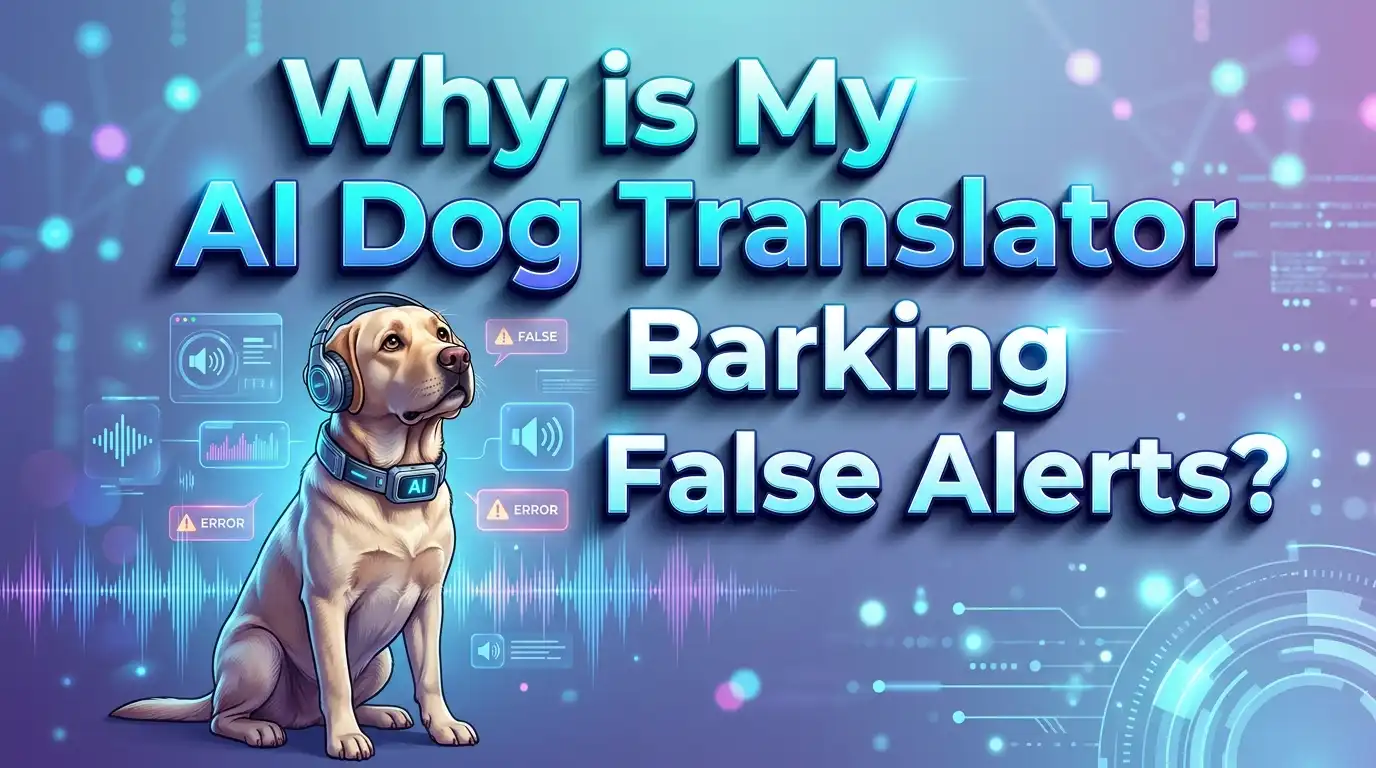
Why Is My AI Dog Translator Barking False Alerts?
You got an AI dog translator because you wanted to understand your furry best friend better. But instead of helpful insights, you keep getting confusing or flat-out wrong alerts. Your dog is clearly relaxed on the couch, yet the app screams “anxious” or “scared.” Sound familiar?
You are not alone. Thousands of dog owners are experiencing the same problem right now. AI dog translators are one of the most exciting innovations in pet care technology, but they are also imperfect tools that can misfire in very specific and very fixable ways.
This guide breaks down every major reason your AI dog translator sends false alerts. More importantly, it walks you through step-by-step solutions that actually work. By the time you finish reading, you will know exactly how to get more accurate results from your device or app.
In a Nutshell
- False alerts from AI dog translators are extremely common, and they happen because these tools rely on machine learning models trained on generalized data, not your specific dog’s unique voice and behavior.
- Background noise is one of the biggest culprits. A TV, a fan, or another dog barking nearby can confuse the AI and trigger incorrect emotional readings.
- Breed differences matter enormously. A Chihuahua and a Labrador produce very different vocalizations, and many apps still lack strong breed-specific training data to handle this gap accurately.
- Context is the missing piece. AI translators mostly analyze sound. They cannot see your dog’s tail, ears, or body posture, which means they are working with incomplete information every single time.
- Most false alert problems have practical, user-side fixes. Adjusting your device placement, reducing ambient noise, retraining the app with new samples, and updating your software can dramatically cut false alerts.
- AI dog translation technology is still evolving. Studies show that multimodal AI systems combining sound, motion data, and visual input reach higher accuracy rates, so pairing your translator app with careful personal observation gives you the best results today.
What Is an AI Dog Translator and How Does It Actually Work?
Before you can fix the problem, you need to understand the tool. An AI dog translator is an app or wearable device that captures your dog’s sounds, and sometimes movement, and uses machine learning algorithms to interpret them as emotional states or needs.
The system works by comparing your dog’s bark against a large database of previously recorded barks labeled with context. For example, a short, high-pitched bark is often tagged as “playful” in the training data. A low, repetitive bark might be tagged as “alert.” When your dog makes a sound, the AI matches it to the closest pattern in its database and produces an alert.
The technology draws heavily on human speech recognition models. Research published on arXiv demonstrated that AI models originally trained on human speech were adapted to achieve around 70% accuracy in decoding dog barks. That is impressive progress, but it also means a 30% error rate is built right into the foundation.
Some newer devices go further by using microphones, motion sensors, and even physiological data like heart rate to produce readings. A Chinese startup called Pettichat, for instance, claims 94.6% real-time translation accuracy using this multimodal approach. However, most consumer-level apps on the market today still rely primarily on audio analysis, which leaves a lot of room for false alerts.
Understanding this baseline helps you set realistic expectations and target the right fixes.
Your Dog’s Breed Is Confusing the Algorithm
This is one of the most overlooked causes of false alerts, and it affects millions of dog owners. AI models learn from data, and the quality of that data is everything. If the training dataset used to build your translator app had a heavy representation of Golden Retrievers but very few Shiba Inus, the model simply does not know what a “normal” Shiba Inu bark sounds like.
Different breeds have dramatically different vocal patterns. A Beagle produces a loud, long howl. A Basenji barely barks at all and makes a unique yodel sound. A German Shepherd has a deep, authoritative bark very different from the sharp yips of a Yorkshire Terrier. When a breed’s vocalization falls outside the model’s strong training zones, the AI guesses using the closest match it has. That guess is often wrong.
Here is what you can do right now:
- Check your app’s settings for a breed selection option and make sure you have selected the correct breed for your dog.
- If your app does not have breed-specific settings, contact the developer and ask whether breed support is on their roadmap.
- Look for apps and devices that explicitly advertise breed-specific AI models, as these tend to perform better for non-standard breeds.
- If your app allows you to submit your own bark samples for model training, do it. The more labeled data from your specific breed you feed in, the better the results become over time.
Breed diversity in training data is an active area of research. AI bark translator systems that process data from multiple breeds, ages, and situations show stronger generalization. Knowing your tool’s limitations here puts you one step ahead.
Background Noise Is Hijacking the Microphone
Your AI dog translator does not know the difference between your dog’s bark and your neighbor’s dog barking three houses away. It cannot filter out the TV unless it has been specifically programmed to do so. Background noise is one of the most common technical causes of false alerts, and it is one of the easiest to address.
When the microphone picks up ambient sound that resembles a dog vocalization, such as a squeaky toy, a child crying, or even certain music frequencies, the AI may register a false positive. Similarly, if you are using a collar device and your dog is panting near a running air conditioner, the layered sounds can confuse the model into producing an incorrect emotional reading.
Follow these steps to reduce background noise interference:
- Move to a quieter room when you want an accurate translation reading.
- Turn off TVs, radios, and loud appliances during recording or monitoring sessions.
- Check that your app has a noise cancellation or sensitivity adjustment setting and calibrate it to your environment.
- If you are using a collar device, make sure the microphone is positioned correctly against your dog’s body and not rubbing against fur in a way that creates constant friction noise.
- Test the device in a quiet environment first to establish a clean baseline for your dog’s sounds.
A user review on Apple’s App Store noted that one dog translator app translated the sound of silence into words, which means some apps fire alerts even with no input at all. That is a sensitivity calibration problem, and adjusting the threshold in your app settings should fix it immediately.
The Device or App Placement Is Off
Where you place the microphone relative to your dog’s mouth and body matters more than most people realize. An AI translator relies on clean, direct sound input to make accurate assessments. If the device is too far away, the audio signal degrades and the AI fills in the gaps with guesses.
Distance and angle affect the frequency profile of a bark. A bark captured from two feet away sounds measurably different from the same bark captured from six inches away. When the frequency profile shifts, the AI may classify it as a completely different emotional state. This is especially common with wearable collar devices if the collar is fitted too loosely or the microphone unit has shifted to the side of the dog’s neck.
To fix placement problems, take these steps:
- Ensure collar devices fit snugly with the microphone positioned at the front of the throat area.
- For smartphone apps, hold your phone within one to two feet of your dog during recording.
- Avoid placing the device against walls or furniture that can create echo and reverb, which distort the frequency data the AI reads.
- If your app uses your phone’s built-in microphone, make sure the microphone port is not covered by a case or your hand.
- Test different distances and positions and note which placement produces the most consistent and accurate results for your specific dog.
Getting placement right is a simple mechanical fix, but it makes a surprisingly large difference in output accuracy.
The App Lacks Enough Personal Data on Your Dog
Generic AI models are trained on thousands of dogs, but they have never heard your dog before you downloaded the app. Your dog has a unique voice, unique behavioral patterns, and a unique emotional signature. A model that has never been exposed to your dog’s specific sound profile will produce generic outputs that may not match your dog’s actual state.
This is the personalization gap, and it is one of the fundamental challenges in AI pet translation. The more the app learns about your individual dog, the more accurate it becomes. But that learning process requires time and deliberate input from you.
Here is how to accelerate the personalization process:
- Use your app’s feedback or correction feature every time it produces a wrong alert. Mark the correct emotion and submit it so the model can learn.
- Actively record your dog in known emotional states. For example, record during playtime when you know your dog is happy. Record during a thunderstorm when you know your dog is anxious. Label these samples correctly in the app.
- Use the app consistently over several weeks. Many machine learning-based apps improve significantly after 30 to 60 days of regular use with quality feedback.
- Avoid deleting and reinstalling the app frequently, as this can wipe the personalized data the model has collected about your dog.
The apps that allow user-submitted data corrections and personalized sound libraries tend to produce far fewer false alerts over time compared to static models.
Your Dog’s Age Is Creating Mismatches
A puppy does not sound like an adult dog. An elderly dog does not sound like a two-year-old at peak health. Vocal patterns change significantly across a dog’s lifespan, and many AI translators are not designed to adjust for these changes automatically.
Puppies have higher-pitched vocalizations and shorter bark durations. Senior dogs may have raspier or quieter vocalizations due to muscle changes around the larynx. If the app’s training data skewed heavily toward adult dogs in prime health, it will consistently misread puppies and senior dogs.
Steps to address age-related mismatches:
- Check whether your app has age-specific settings or profiles and configure them correctly for your dog’s current life stage.
- If age settings are not available, document this as a limitation and compensate by increasing the frequency of manual feedback corrections.
- Rerun the calibration or onboarding process in your app every six to twelve months as your dog ages and their vocal profile shifts.
- For senior dogs showing behavioral changes, combine app data with regular veterinary checkups rather than relying solely on AI alerts.
Being aware of your dog’s life stage helps you interpret alerts with the right filter, even when the AI does not have this context built in.
The AI Is Missing Body Language Data
This is perhaps the deepest structural limitation of most AI dog translators on the market today. Dogs communicate primarily through body language, not sound. Tail position, ear angle, posture, and eye contact all carry meaning that a microphone simply cannot capture.
Research consistently shows that understanding a dog’s emotional state requires reading the whole body, not just listening to vocalizations. When an AI translator bases its output only on audio, it is working with perhaps 40 to 50% of the available communication data. The other half is invisible to it.
A 2024 study published in Nature’s Scientific Reports showed that large vision-language AI models still struggle to accurately classify dog emotional states from images alone. This tells us that even video-based AI struggles without proper multimodal training. Audio-only tools face an even steeper hill.
Here is how to work around this limitation:
- Never rely on an AI translator alert in isolation. Always observe your dog’s physical posture, tail, ears, and eyes alongside any alert you receive.
- Use the app as one data point, not as the final word on your dog’s emotional state.
- Consider upgrading to a multimodal device that combines audio analysis with motion sensing and, if available, physiological monitoring.
- Learn the basic principles of dog body language so you can cross-check AI outputs against your own informed observations.
Combining AI tools with your own trained observation is the most effective approach available right now.
Software Bugs and Outdated Models Are Causing Problems
Technology breaks. Machine learning models become outdated as new research emerges. An app you downloaded eighteen months ago may be running on an AI model that has since been improved or corrected by the developer. If you have not updated the app, you are still running the old, less accurate version.
Bugs in audio processing code can also cause persistent false alerts. One well-documented issue is that some apps trigger alerts even in complete silence, suggesting a problem with the threshold calibration in the code rather than any actual sound input. These bugs are usually patched in updates.
To address software-related false alerts:
- Open your app store and check whether updates are available for your dog translator app. Install them immediately.
- Read the update release notes, which often describe specific bug fixes for false alert or accuracy issues.
- Check the developer’s support page or community forum for known issues with your app version.
- If bugs persist after updating, report them to the developer with a description of when and how the false alerts occur. This helps them identify and fix the problem faster.
- Restart the app fully between sessions rather than leaving it running in the background, as memory buildup can affect processing accuracy.
Staying current with updates is one of the simplest and most impactful maintenance steps you can take.
Your Wi-Fi or Bluetooth Connection Is Interfering
Many AI dog translator devices connect to a smartphone via Bluetooth, and some cloud-based apps send audio data to remote servers for processing. A weak or unstable connection can corrupt the data mid-transmission, causing the AI to analyze incomplete or garbled audio and produce a false alert.
Bluetooth interference from nearby devices, walls, and other electronics is a real and common problem with wearable pet tech. Similarly, if your app processes audio in the cloud, a slow internet connection can delay or corrupt the analysis.
Fix connection issues with these steps:
- Keep your smartphone within 10 feet of your Bluetooth-connected translator device for a reliable signal.
- Remove other Bluetooth devices from the area during initial testing to identify whether interference is causing problems.
- If your app uses cloud processing, test it on a strong Wi-Fi connection and compare accuracy to results on a weak signal.
- Enable airplane mode and then re-enable Bluetooth on your phone to reset the Bluetooth stack, which can clear connection artifacts.
- Check for firmware updates on your hardware device, as these often include Bluetooth stability improvements.
A clean, stable connection gives the AI the full-quality audio data it needs to make accurate assessments.
You Have Not Calibrated the App to Your Environment
Different homes have different acoustic environments. A tiled kitchen creates echo and reverb. A carpeted living room absorbs sound and changes the frequency profile of a bark. An open backyard introduces wind noise. The AI model does not automatically know what your home sounds like, and without calibration, it is trying to interpret your dog’s sounds through the wrong acoustic lens.
Some premium apps offer an environmental calibration feature that lets the system learn the baseline noise profile of your home. If your app has this feature and you have not used it, that alone could be the source of most of your false alerts.
Steps to properly calibrate your environment:
- Find the calibration or setup option in your app’s settings menu and run it in the space where your dog spends most of their time.
- Run the calibration process separately for different rooms if your dog moves between spaces regularly.
- Redo the calibration if you move to a new home, rearrange furniture significantly, or introduce new appliances that change the ambient sound landscape.
- If your app does not offer environment calibration, manually adjust the sensitivity slider downward in noisy environments and upward in very quiet ones.
- Document the settings that produce the fewest false alerts in each environment so you can quickly restore them if settings get reset.
Environmental calibration is a one-time setup step that pays ongoing dividends in accuracy.
Emotional Context Is Too Ambiguous for the Current AI
Not every bark maps cleanly to a single emotion. Dogs produce what researchers call graded vocalizations, meaning their sounds exist on a spectrum rather than falling into discrete categories. A bark can simultaneously carry elements of excitement and mild anxiety. The AI, however, must pick one label, and that label may be technically inaccurate for a nuanced emotional state.
A study published in the journal Animal Behaviour showed that barks are “graded vocalizations that range from harsh, low-frequency calls to harmonically rich, higher-frequency sounds.” When a bark falls between two clear categories, the AI defaults to the closest match in its training data, which may not reflect your dog’s true state at all.
Here is how to manage ambiguous emotion classification:
- Treat alerts that arrive during transitional moments, like when play is winding down or when your dog is settling after excitement, with extra skepticism.
- Look for apps that assign a confidence percentage to their alerts. A 95% confidence alert is far more meaningful than a 51% confidence alert.
- Use the alert categories as a general signal rather than a precise diagnosis.
- Keep a simple log of which situations produce consistent alerts versus which produce noisy or contradictory ones. This helps you build a personalized map of your dog’s communication patterns.
- Share this log with your app’s developer if they have a feedback program. Your real-world data helps them improve the model for everyone.
Accepting a degree of ambiguity while still working toward better calibration is the practical approach for today’s technology.
When to Trust the AI and When to Trust Your Gut
There is a point where technology steps back and your knowledge as your dog’s owner steps forward. You have watched your dog for months or years. You know their habits, their triggers, and their baseline behavior. That knowledge is invaluable and no AI can fully replicate it yet.
If your AI translator sends an alert that completely contradicts what you are observing with your own eyes, trust your observation. If the alert aligns with subtle signs you have noticed but were not sure about, the AI may be picking up on something real. The goal is to use AI as an assistive layer, not as a replacement for your own intuition and observation.
Here is how to build a productive human-AI partnership:
- Set a personal rule that you will always cross-check any alert against your direct observation before reacting.
- Keep a journal for two weeks noting each alert, your observation at the time, and whether you felt the alert was accurate. Review the patterns.
- Talk to your veterinarian about behavioral changes your AI translator flags repeatedly. A vet can confirm or rule out underlying health causes.
- Use your dog’s individual history as the benchmark for accuracy. An alert pattern that repeats consistently in the same situations likely reflects something real.
- Adjust your app settings based on your journal findings to reduce categories that consistently produce false alerts for your specific dog.
Your partnership with AI tools works best when you are an active, critical participant rather than a passive receiver of alerts.
How to Choose a Better AI Dog Translator Going Forward
If your current app or device consistently produces false alerts even after you have applied all the fixes above, it may simply be a low-quality tool. The market has a wide range of products with very different levels of accuracy and reliability.
Not all AI dog translators are created equal. Some are primarily entertainment apps with no serious scientific backing. Others are built on peer-reviewed research and multi-year datasets. Knowing how to tell the difference saves you time and frustration.
What to look for in a higher-quality AI dog translator:
- Transparent information about the AI model and training dataset used.
- Breed-specific and age-specific calibration options built into the app.
- A personalization or learning feature that improves accuracy based on your dog’s specific data.
- A confidence score attached to each alert so you know how certain the AI is.
- Regular software updates with documented accuracy improvements.
- Multi-sensor input that combines audio with motion or physiological data for more complete analysis.
- Positive independent reviews from veterinary professionals or animal behaviorists.
Investing in a tool backed by real science and active development is the single best long-term solution to persistent false alert problems.
Frequently Asked Questions
Why does my AI dog translator keep giving wrong alerts even in silence?
This is a sensitivity calibration issue. Some apps have their detection threshold set too low, causing them to trigger on ambient noise or even electronic interference. Go into your app’s settings and lower the sensitivity or trigger threshold. If the problem persists after that, it is likely a software bug and you should check for updates or report it to the developer.
Can the breed of my dog really affect translator accuracy that much?
Yes, significantly. Different breeds have distinct vocal frequencies, bark durations, and vocalization styles. If your dog’s breed is underrepresented in the app’s training data, the AI will consistently misclassify their sounds. Always select your dog’s breed in the app settings if that option is available, and look for apps that explicitly advertise breed-specific training.
How long does it take for an AI dog translator to learn my dog’s sounds?
Most machine learning-based apps improve noticeably after three to six weeks of consistent use with regular user feedback. The more labeled samples you provide in known emotional contexts, the faster the model adapts to your dog’s unique voice. Some apps show measurable improvement in as little as two weeks with active participation.
Is background noise really causing my false alerts?
Very likely yes. Background noise is one of the most common causes of false alerts in AI dog translators. TVs, other pets, outdoor traffic, air conditioning, and even music can trigger the audio detection system. Test your app in a completely quiet room with no other sounds present and compare the alert frequency to what you experience normally. The difference is usually dramatic.
Should I be concerned if the AI keeps flagging my dog as anxious?
If the alert is consistent and aligns with behaviors you can observe, like panting, pacing, lip licking, or whale eye, take it seriously and consult your veterinarian. If the anxious alert fires randomly during clearly calm moments, it is almost certainly a false alert caused by one of the calibration or noise issues described in this guide. Document the pattern and apply the relevant fixes.
Do veterinarians trust AI dog translators?
Most veterinary professionals view current AI dog translators as useful supplementary tools rather than diagnostic instruments. They can help owners pay closer attention to their dog’s behavior and flag potential concerns worth discussing with a vet. However, no qualified veterinarian would make a health diagnosis based on an AI translator alert alone. Use these tools to improve your awareness and always consult a vet for health concerns.
Will AI dog translators get better in the future?
Yes, and they already are improving quickly. Multimodal systems that combine audio with body movement sensors and physiological monitoring are showing accuracy rates in the 85 to 95% range in controlled studies. As more data gets collected from diverse breeds across diverse environments, the models will become significantly more reliable. The technology today is a strong starting point, and the trajectory is clearly upward.

Hi, I’m Simmy — the founder and voice behind AI Gadgets Insight. I’m a tech enthusiast who loves exploring the latest AI gadgets, smart devices, and innovative tech products. I started this blog to help people make smarter tech choices with honest reviews, easy-to-follow comparisons, and practical buying guides.