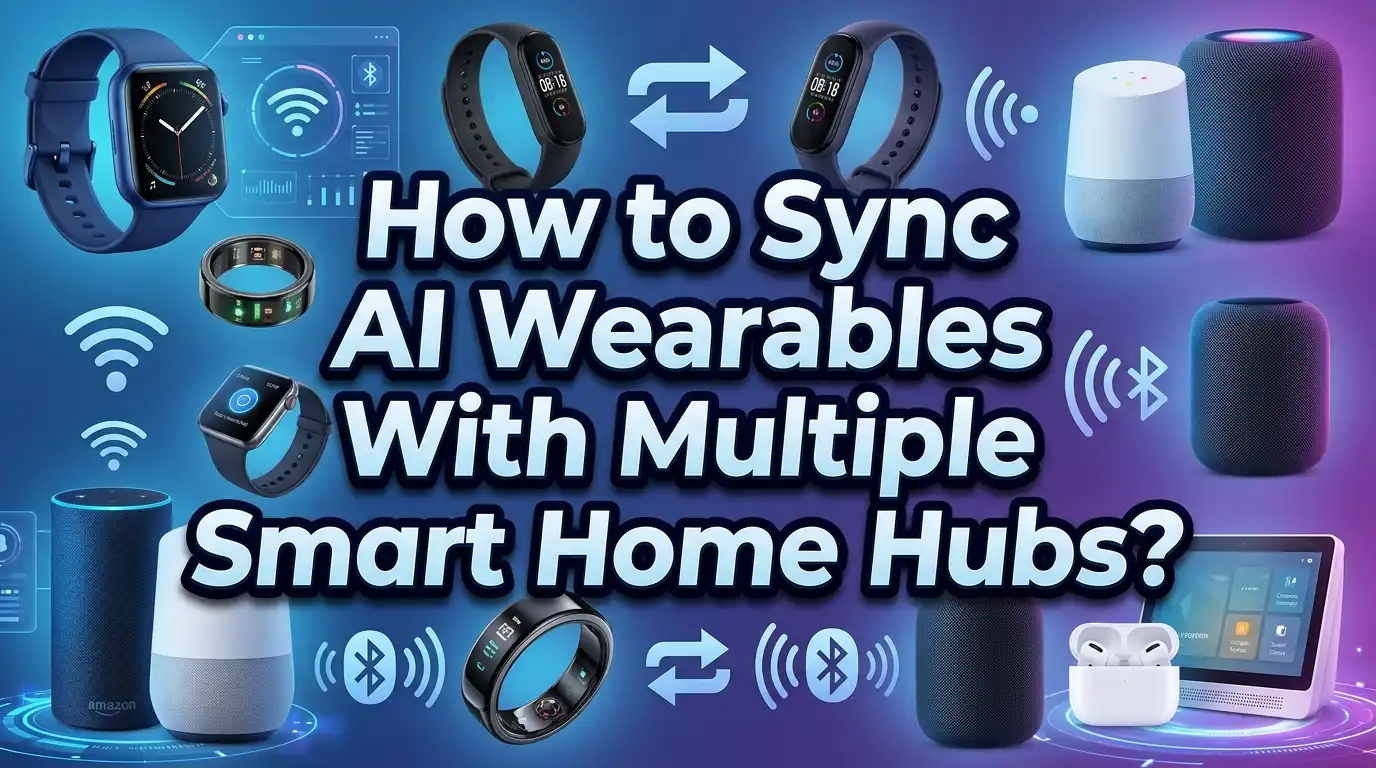
How to Sync AI Wearables With Multiple Smart Home Hubs?
You just bought a shiny AI wearable. Maybe it is a smart ring, AI glasses, or an AI pendant. You want it to talk to your Alexa, Google Home, and SmartThings hub all at once. But nothing seems to connect the way you expected. Sound familiar?
The smart home market has grown fast. AI wearables have become powerful personal assistants you can wear on your body. They track your health, respond to voice commands, and even trigger automations in your home.
The problem starts when you own more than one smart home hub. Each hub uses its own app, its own protocols, and its own rules. Getting a single wearable to work across all of them can feel like solving a puzzle with missing pieces.
This guide gives you clear, practical answers. You will learn exactly how to sync your AI wearable with multiple smart home hubs.
Key Takeaways
- The Matter protocol is your best friend. Matter is a universal smart home standard backed by Apple, Google, Amazon, and Samsung. If your AI wearable and hubs support Matter, syncing them becomes much simpler because they all speak the same language. Check your devices for Matter compatibility before you try anything else.
- Middleware platforms bridge the gaps. Tools like IFTTT, Home Assistant, and Hubitat act as a central bridge between your wearable and multiple hubs. They let you create automations that trigger actions across different ecosystems from a single input. This is the most reliable approach for multi hub setups.
- Voice assistants serve as a unifying layer. Your AI wearable likely connects to Alexa, Google Assistant, or Siri. Each of these voice assistants can control devices on multiple hubs. Use the voice assistant as a central controller for cross platform commands.
- Wi Fi stability is critical. Most sync failures between wearables and hubs happen because of weak or unstable Wi Fi. A strong mesh network with consistent coverage eliminates the majority of connectivity problems users report.
- Simple commands work best. Real world testing shows AI wearables handle broad commands like “I’m leaving” or “Goodnight” much better than precise ones like “Set lights to 42%.” Design your automations around simple triggers for best results.
- Always keep a backup control method. Physical switches and phone apps should stay accessible. AI wearable integration is a convenience layer, not a replacement for direct control of your smart home devices.
What Are AI Wearables and Why Do They Need Smart Home Hubs
AI wearables are devices you wear on your body that use artificial intelligence to process data, respond to commands, and make decisions. Popular examples include AI smart rings, AI glasses like Meta Ray Bans, AI pendants, and advanced smartwatches with built in AI assistants. These devices go beyond basic fitness tracking. They listen to your environment, understand context, and can trigger actions based on what they learn.
Smart home hubs act as the central control point for all your connected devices. Hubs like Amazon Echo, Google Nest Hub, Samsung SmartThings, and Apple HomePod manage communication between your lights, locks, thermostats, cameras, and sensors. They translate commands into signals your devices understand.
AI wearables need smart home hubs because they cannot directly control most smart devices on their own. The wearable sends a command to a hub, and the hub relays it to the right device. Without a hub, your wearable is limited to its own onboard features. The real power comes from connecting the two.
The challenge appears when you own hubs from different brands. Your Alexa controls the living room, Google Nest manages the kitchen, and SmartThings handles security sensors. Your AI wearable must find a way to communicate with all three. This requires careful setup and the right tools.
Why Syncing With Multiple Hubs Is Difficult
Multiple smart home hubs create a fragmented ecosystem. Each hub runs its own software, uses its own communication protocols, and manages its own device list. Alexa speaks to Zigbee and Wi Fi devices differently than Google Home does. SmartThings has its own API layer. Apple HomeKit locks things down with strict security requirements.
Your AI wearable typically connects to one primary voice assistant. If your wearable pairs with Google Assistant but your bedroom lights run through Alexa, you face a direct compatibility gap. The wearable cannot send commands where the assistant has no reach.
Protocol differences add another layer of difficulty. Some hubs use Zigbee. Others rely on Z Wave or Thread. Your wearable communicates over Bluetooth and Wi Fi, which means it needs a translation layer to reach devices on other protocols. This translation does not always happen automatically.
Cloud dependency also creates problems. Many wearables send commands through cloud servers. If the cloud service for your wearable or any of your hubs goes down, the sync breaks. Latency can also increase, making commands feel slow or unresponsive.
Pros of using multiple hubs: You get access to a wider range of compatible devices and can use the best features from each ecosystem. Cons: Setup is more complex, troubleshooting takes longer, and automations can break at any link in the chain.
Check Protocol Compatibility Before You Start
Before you attempt any syncing, check which protocols your AI wearable and each hub support. This single step saves you hours of frustration. Make a simple list with three columns: your wearable’s supported protocols, each hub’s supported protocols, and the overlap between them.
Most AI wearables in 2026 connect through Bluetooth Low Energy and Wi Fi. Some newer models also support Thread, which is a low power mesh networking protocol used by Matter devices. If your wearable supports Thread or Matter, you have a significant advantage because Matter is designed to work across all major hub ecosystems.
Check each hub’s protocol list in its app settings or on the manufacturer’s website. Amazon Echo devices support Zigbee, Bluetooth, Wi Fi, Matter, and Thread. Google Nest hubs support Wi Fi, Bluetooth, Matter, and Thread. SmartThings supports Zigbee, Z Wave, Wi Fi, Matter, and Thread. Apple HomePod supports Wi Fi, Bluetooth, Matter, and Thread.
The common ground is usually Matter and Wi Fi. If your wearable can send commands through an app that supports Matter, you can reach devices on any Matter compatible hub. If it cannot, you need a middleware solution to bridge the gap. Write down where the overlaps exist and where the gaps are. This map becomes your action plan.
Pros of checking compatibility first: You avoid wasting time on setups that will never work. Cons: It requires some research time upfront and protocol information is not always clearly listed by manufacturers.
Use the Matter Protocol as Your Universal Bridge
Matter has changed how smart home devices communicate. Launched by the Connectivity Standards Alliance with support from Apple, Google, Amazon, and Samsung, Matter creates a single language that all major hubs understand. Version 1.4.1 made device setup even simpler with QR code and NFC pairing.
If your AI wearable’s companion app supports Matter, you can register it as a Matter device on multiple hubs at the same time. This is called multi admin, and it is one of Matter’s most powerful features. Your wearable can appear on Alexa, Google Home, and Apple Home simultaneously. Commands sent from the wearable reach whichever hub manages the target device.
To set this up, open your wearable’s app and look for Matter pairing options. Scan the Matter QR code or use NFC to add the wearable to your first hub. Then repeat the process with your second and third hubs. Each hub recognizes the wearable as a connected device.
Not all AI wearables support Matter directly yet. Some rely on their companion apps to bridge the connection. In this case, the app acts as the Matter controller, and the wearable sends commands through the app. This adds a small delay but still works across multiple hubs.
Pros of Matter: Universal compatibility, local network communication for speed, and strong encryption for security. Cons: Not all older devices support Matter, and some features may still require brand specific apps for full functionality.
Set Up a Central Middleware Platform
A middleware platform acts as a universal translator between your wearable and all your hubs. Home Assistant is the most powerful option for this purpose. It is an open source platform that runs on a small computer or dedicated device in your home. It connects to over 2,000 different smart home brands and services.
Install Home Assistant on a Raspberry Pi, a mini PC, or use the Home Assistant Green device. Once running, add each of your smart home hubs as an integration. Go to Settings, then Devices and Services, and search for your hub brands. Add Alexa, Google Home, SmartThings, and any other platform you use.
Next, connect your AI wearable to Home Assistant. Many wearables with Wear OS support the Home Assistant Companion app directly. For AI pendants or rings, check if the wearable’s app offers webhook support or API access. You can create automations in Home Assistant that listen for triggers from your wearable and then execute actions across any connected hub.
For example, your AI wearable detects you have arrived home through its GPS sensor. Home Assistant receives this signal and simultaneously unlocks your SmartThings door lock, turns on your Alexa controlled lights, and adjusts your Google Nest thermostat. One trigger, multiple hubs, one seamless response.
Pros of Home Assistant: Extreme flexibility, local processing, no subscription fees, and massive community support. Cons: Requires technical comfort with setup, occasional updates can break integrations, and the initial learning curve is steep for beginners.
Connect Through IFTTT for Simple Automations
IFTTT stands for If This Then That. It is a cloud based automation platform that connects hundreds of apps and devices. If you want a simpler alternative to Home Assistant, IFTTT is a solid choice for basic cross hub automations.
Create an IFTTT account and connect your AI wearable’s service. Most popular wearables offer an IFTTT channel or integration. Then connect each of your smart home hubs as separate services. Alexa, Google Home, SmartThings, and many others are available on the platform.
Build applets that link your wearable’s triggers to actions on different hubs. For example, create an applet that says: “If my AI wearable detects I am asleep, then turn off all SmartThings lights and set Google Nest thermostat to 68 degrees.” Each applet handles one trigger and one action, but you can create multiple applets for the same trigger to affect devices on different hubs.
The free tier of IFTTT allows a limited number of applets. The paid tiers unlock more applets and faster execution times. Cloud processing means there is a slight delay between the trigger and the action, usually one to three seconds.
Pros of IFTTT: Easy to set up, no coding required, works with a huge number of services, and accessible from anywhere. Cons: Cloud dependent so it fails if the internet goes down, free tier is limited, and it does not support complex conditional logic well.
Use Voice Assistants as a Unifying Control Layer
Your AI wearable almost certainly connects to at least one major voice assistant. This voice assistant can become your primary tool for controlling devices across multiple hubs. The trick is to link all your hubs to that single voice assistant.
If your wearable uses Google Assistant, open the Google Home app and link your SmartThings account, your Alexa compatible devices through compatible skills, and any other third party services. Google Home now shows devices from all linked platforms. When you speak a command through your wearable, Google Assistant routes it to the correct hub automatically.
The same approach works with Alexa. Open the Alexa app, go to Skills, and enable the SmartThings skill, the Google Home compatible skill, or any other hub integrations. Alexa then controls devices across ecosystems. Your AI wearable sends the voice command to Alexa, and Alexa handles the rest.
Create routines within your voice assistant app that combine actions across different hubs. A single “Good Morning” command from your wearable can turn on Alexa lights, adjust a Google thermostat, and unlock a SmartThings door lock. Group related devices into rooms within the voice assistant app so commands like “Turn off the kitchen” work regardless of which hub each device belongs to.
Pros: Simple setup, uses existing voice assistant infrastructure, and allows natural language commands. Cons: Requires internet connection for cloud processing, accuracy can vary with background noise, and some hub to hub integrations have limited feature support.
Optimize Your Wi Fi Network for Reliable Syncing
Most sync failures between AI wearables and smart home hubs trace back to Wi Fi problems. Your wearable, your phone acting as a bridge, and each hub all need stable internet connections. A weak signal at any point breaks the chain.
Start by running a speed test in every room where you have a hub or frequently use your wearable. Look for rooms where download speeds drop below 10 Mbps or where latency exceeds 50 milliseconds. These are your problem zones. A mesh Wi Fi system with nodes placed throughout your home solves most coverage gaps.
Separate your smart home devices onto a dedicated 2.4 GHz network. Many smart hubs and wearables perform better on 2.4 GHz because it offers wider range than 5 GHz. Keep your personal devices on the 5 GHz band to reduce congestion on the smart home network.
Assign static IP addresses to each hub in your router settings. This prevents IP conflicts that can randomly disconnect hubs from the network. Also check that your router’s firmware is current. Old router firmware can cause intermittent connectivity drops that are hard to diagnose.
Pros of network optimization: Fixes the root cause of most sync issues and improves performance for all connected devices. Cons: May require purchasing a new router or mesh system, and static IP configuration requires basic networking knowledge.
Create Cross Hub Automations That Actually Work
The goal of syncing your AI wearable with multiple hubs is to create automations that span ecosystems. Keep your automations simple, focused, and reliable. Users who have tested AI wearable home integration report that broad, clear commands produce the best results.
Start with arrival and departure routines. Your wearable detects when you leave home through GPS or Bluetooth proximity. This triggers a “leaving home” automation that locks doors on SmartThings, sets the Alexa thermostat to away mode, and turns off Google Home connected lights. Build this in your middleware platform or through linked voice assistant routines.
Create bedtime and wake up routines next. These are the second most useful automations for wearable users. Your wearable’s sleep detection or a simple voice command activates the routine. Lights dim on one hub, doors lock on another, and the alarm is set on a third.
Test each step independently before combining them. Make sure the SmartThings lock works on its own, the Alexa thermostat responds correctly, and the Google lights turn off reliably. Then chain them together in your automation platform. If any single step fails during testing, the combined routine will also fail.
Avoid commands that require precise values. Research and real world testing show that wearable voice recognition often misinterprets exact numbers. Use presets instead. Create a “Movie Mode” scene in each hub’s app, then trigger all of them with one wearable command.
Troubleshoot Common Sync Failures
When your AI wearable stops communicating with one or more hubs, follow a structured troubleshooting checklist. Start from the simplest fix and work your way up.
Step one: Restart everything. Power cycle your wearable, your phone, and each hub. Turn them off, wait 30 seconds, and turn them back on. This clears temporary software glitches that cause the majority of sync issues.
Step two: Check for firmware and app updates. Open each hub’s app and look for pending updates. Check your wearable’s companion app for new versions. Outdated firmware is the second most common cause of sync problems. Manufacturers regularly release patches that fix connectivity bugs.
Step three: Verify account links. Open your middleware platform or voice assistant app and confirm that all hub accounts are still connected. Expired authentication tokens can silently break connections. Re link any services that show as disconnected.
Step four: Test your internet connection. Run a speed test near each hub. If one hub has weak signal, move it closer to a Wi Fi access point or add a mesh node nearby. Also check that your internet service provider is not experiencing an outage.
Step five: Check device limits. Some hubs have a maximum number of connected devices. If you recently added new devices and your wearable stopped syncing, you may have hit the limit. Remove unused devices to free up slots.
Handle Security and Privacy Across Multiple Hubs
Connecting your AI wearable to multiple hubs creates several access points for your smart home data. Each connection is a potential vulnerability, so security matters. Take these steps to protect your setup.
Enable two factor authentication on every hub account and on your wearable’s companion app. This prevents unauthorized access even if one password is compromised. Use a unique, strong password for each service. A password manager makes this manageable.
Review the permissions your wearable app requests. Some AI wearables collect location data, voice recordings, and biometric information. Check which data gets shared with each connected hub. Disable any data sharing that is not necessary for your automations to function.
Use local processing whenever possible. Home Assistant processes automations locally without sending data to external servers. Matter also supports local communication between devices. The less data leaves your home network, the lower your privacy risk.
Regularly audit connected devices in each hub. Remove any devices you no longer use. Check for unfamiliar devices that may have been added without your knowledge. Set up notifications for new device connections on hubs that support this feature.
Pros of strong security practices: Protects your home from unauthorized access and reduces data exposure. Cons: Adds extra steps to the setup process and can make troubleshooting slightly more complex because of additional authentication layers.
Plan for Future Compatibility
The smart home industry moves fast. Choosing future proof devices and platforms saves you from rebuilding your setup every year. Focus on open standards and flexible platforms.
Prioritize Matter compatible devices for new purchases. Matter adoption is growing rapidly, and it will become the default communication standard for smart homes. Devices that support Matter today will integrate more easily with whatever hubs and wearables release in the future.
Choose a middleware platform with active development. Home Assistant releases updates regularly and has a large community building new integrations. This means when a new AI wearable launches, someone in the community will likely build an integration for it within weeks.
Keep your hub count reasonable. Every hub you add increases complexity. If two hubs serve overlapping purposes, consider consolidating to the one with better protocol support. A SmartThings hub that supports Zigbee, Z Wave, and Matter may replace two single protocol hubs.
Watch for Thread adoption in wearables. Thread is a mesh networking protocol that works with Matter and does not rely on a central hub for communication. As more AI wearables adopt Thread, direct device to device communication will reduce your dependence on hubs entirely.
Step by Step Quick Start Guide
Here is a condensed workflow to get your AI wearable synced with multiple hubs today. Follow these steps in order for the smoothest experience.
First, list all your hubs and the protocols each one supports. Write down the voice assistant each hub connects to. Note which protocol your AI wearable uses.
Second, choose your integration method. If your wearable supports Matter, use multi admin to register it on each hub directly. If not, select a middleware platform like Home Assistant or IFTTT.
Third, strengthen your Wi Fi. Make sure all hubs and your wearable have strong, stable connections. Consider a mesh network if you have dead zones. Put smart home devices on a separate 2.4 GHz network.
Fourth, link all hub accounts to your chosen voice assistant or middleware platform. Confirm each connection works by testing a simple command to each hub individually.
Fifth, build your automations one at a time. Start with a departure routine and a bedtime routine. Test each one thoroughly. Expand to more complex automations once the basics are reliable.
Sixth, secure everything. Enable two factor authentication. Use unique passwords. Review privacy permissions. Set up alerts for new device connections.
Seventh, maintain your system. Check for firmware updates weekly. Re test automations monthly. Remove unused devices and integrations to keep things clean.
Frequently Asked Questions
Can I sync one AI wearable with three or more smart home hubs at the same time?
Yes, you can. The most effective way is to use a middleware platform like Home Assistant that connects to all your hubs simultaneously. Your wearable sends a command to Home Assistant, and Home Assistant routes it to the correct hub. Alternatively, if your devices support Matter, you can use multi admin to register across multiple hubs directly. There is no hard limit on how many hubs you can connect, but each additional hub increases the chance of latency or sync issues.
Do I need a strong internet connection for cross hub syncing?
A stable internet connection is essential for cloud based methods like IFTTT and voice assistant routines. If your internet goes down, those automations stop working. However, local platforms like Home Assistant and Matter based setups can function without internet because they process commands on your local network. For the most reliable experience, invest in a good router and consider having a backup internet connection.
What happens if one hub goes offline while an automation is running?
The automation steps that depend on the offline hub will fail, but steps directed at other hubs will still execute. For example, if your bedtime routine dims Alexa lights and locks a SmartThings door, the lights will still dim even if SmartThings is offline. Your middleware platform should log the failure so you can see what missed. Set up error notifications in Home Assistant or your automation app to catch these issues quickly.
Is the Matter protocol available on all AI wearables?
Not yet. Matter adoption is growing, but many AI wearables still rely on Bluetooth and their companion apps to send commands. Check your wearable manufacturer’s website or app settings to see if Matter is supported. Even if the wearable itself does not support Matter, its companion app might serve as a Matter bridge, passing commands from the wearable to Matter compatible hubs.
Which middleware platform is best for beginners?
IFTTT is the easiest platform for beginners. It requires no coding and has a visual interface for building automations. Home Assistant is more powerful but requires more technical setup. If you are comfortable following online tutorials and want full control over your smart home, Home Assistant is the better long term choice. For quick, simple automations with minimal effort, start with IFTTT and upgrade later if you need more flexibility.

Hi, I’m Simmy — the founder and voice behind AI Gadgets Insight. I’m a tech enthusiast who loves exploring the latest AI gadgets, smart devices, and innovative tech products. I started this blog to help people make smarter tech choices with honest reviews, easy-to-follow comparisons, and practical buying guides.