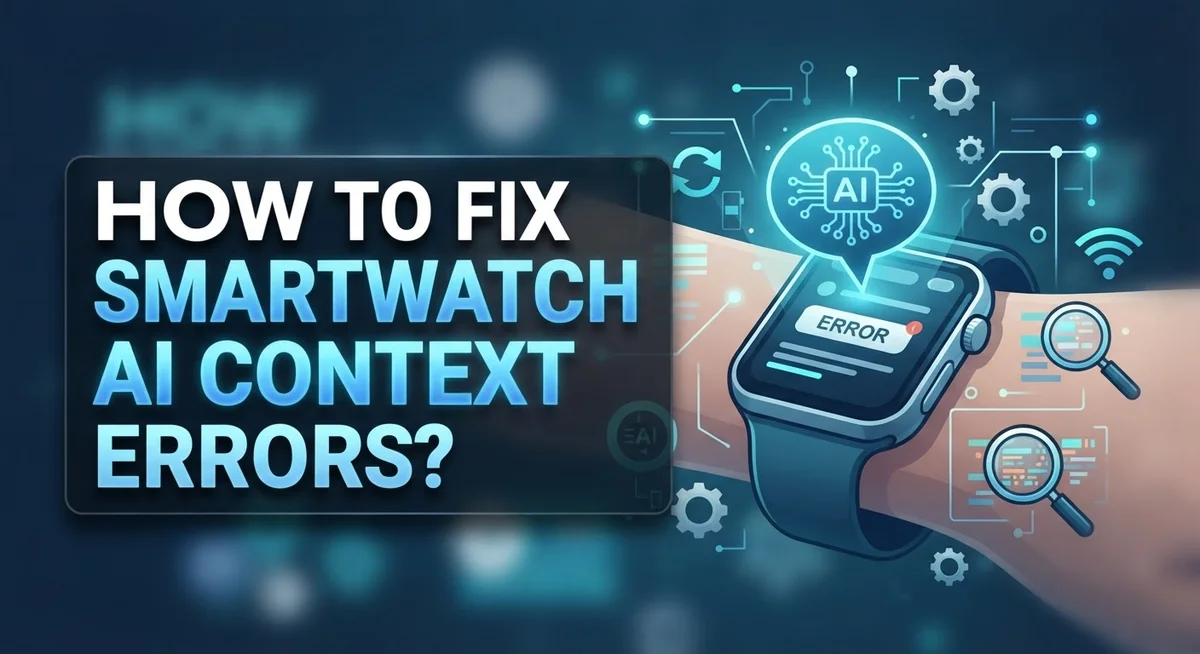
How To Fix Smartwatch AI Context Errors?
Your smartwatch’s AI assistant suddenly gives you a wrong answer. Or it forgets what you told it just minutes ago. These moments are frustrating, but they are actually very common and very fixable.
Most AI context errors happen because of memory limits, not broken software. Every AI assistant has a “context window,” which is basically a cap on how much information it can hold at once. Once that limit fills up, the AI starts losing track of earlier details.
The good news? You can take simple steps to prevent and fix these errors yourself.
This article covers everything you need to know about smartwatch AI context errors. You will learn why they happen, what mistakes make them worse, and how to give your AI assistant the right information to perform better.
By the end, you will know exactly how to get more accurate, helpful responses from your smartwatch AI every single time.
In a Nutshell
Smartwatch AI context errors are common and usually happen because the AI runs out of memory space, not because it is broken.
The AI forgets things because its “context window” has a size limit. It cannot hold every past conversation at once.
Being vague is the biggest mistake. Always give your AI clear, specific questions with enough background detail upfront.
Start a fresh conversation for each new task instead of piling everything into one long chat session.
If the AI gives a bad answer, do not stop there. Reframe your question, add more context, or ask the AI to summarize what it already knows.
Tight feedback loops help a lot. Log the errors you notice, adjust how you phrase things, and your AI will perform better over time.
What Are Smartwatch AI Context Errors and Why Do They Happen?
Smartwatch AI context errors happen when your AI assistant gives you wrong, incomplete, or confusing answers. These errors are not signs of a broken device. Instead, they stem from how AI systems work and manage information.
Every AI model has a context window. Think of it as a container that holds only so much information at once. Once you fill that container with conversation history, old messages, or background data, the AI runs out of space. When the space runs out, the AI cannot remember earlier details or access the full picture of what you need.
Your smartwatch AI also struggles when it receives vague requests. If you ask “What should I do today?” without mentioning your schedule, location, or preferences, the AI has to guess. Poor guesses lead to unhelpful answers.
Another common cause is insufficient context. You might assume the AI knows about a previous conversation or your recent activities. But the AI only knows what you tell it right now. Missing details force the AI to make assumptions, which often go wrong.
Grammar and clarity matter too. Confusing sentences or run-on questions confuse the AI. The AI works best when your words are clear and straightforward.
Finally, multiple simultaneous questions overload the AI. Asking three different things at once creates confusion. The AI tries to handle everything and ends up doing nothing well.
The good news? Most of these errors are preventable. You control what information you give the AI. You choose how specific your requests are. You decide when to start fresh conversations. Small changes in how you interact with your smartwatch AI produce big improvements in accuracy and usefulness.
How Context Window Limits Affect Your Smartwatch AI
Your smartwatch AI has a fixed amount of memory space to work with during each conversation. Think of it like a small notebook that can only hold so much information at once. Once that space fills up, the AI starts forgetting earlier parts of your conversation.
Context window limits are the main culprit behind most smartwatch AI errors. This limit determines how many words or pieces of information your AI can remember during a single session. When you ask complex questions or have long conversations, you quickly use up this available space.
Here’s what happens in practice. Your AI might forget your location preferences halfway through a conversation. It could lose track of what you asked five messages ago. You might notice it gives generic answers instead of personalized ones because it literally cannot remember your earlier requests.
The size of your context window varies depending on your smartwatch model and the AI system it uses. Older devices typically have smaller windows. Newer smartwatches often include larger memory allocations for better performance.
Understanding this limit changes how you should interact with your AI. Instead of expecting one long conversation to work perfectly, you should treat each task as separate. Ask your AI one main question. Wait for the answer. Then start fresh with your next question.
This approach prevents memory overload. Your AI performs better when it focuses on one task at a time. The responses become more accurate and relevant to what you actually need.
When you notice your AI giving odd answers, a context window limit is often the reason. The solution isn’t complicated. Simply restart your conversation and ask your question again with clear, specific details included upfront.
How To Diagnose the Root Cause of AI Context Errors
Diagnosing AI context errors on your smartwatch requires a systematic approach. Start by observing when and where the errors occur. Does your AI struggle after long conversations? Does it forget information you provided earlier? These patterns reveal the root cause.
Check your conversation length first. If you’ve been chatting for several minutes without starting fresh, your context window is likely full. Your AI runs out of memory space to store new information. This is the most common culprit.
Next, review your most recent prompt. Was it vague or unclear? Did you provide enough background details? Vague questions almost always produce poor answers. Compare this with prompts that worked well. Notice the difference in specificity and detail.
Examine whether you asked multiple questions at once. Your AI performs better when handling one task at a time. Bundling several questions together confuses the system and triggers errors.
Look at your grammar and phrasing too. Typos, unclear sentence structure, or confusing wording force your AI to guess what you mean. Clean, clear language helps it understand correctly.
Test a simple fix: start a brand new conversation and ask the same question again. If your AI responds correctly this time, a full context window caused the original error. If the problem persists, the issue lies with how you phrased your request.
Track what you discover. Keep notes on which prompts fail and which succeed. Over time, you’ll see patterns. Maybe your AI struggles with certain topics or question types. This information helps you adjust your approach and prevent future errors.
Step-by-Step Guide To Fixing Smartwatch AI Context Errors
Start by clearing your smartwatch’s conversation history. Most AI errors happen because your device runs out of memory space mid conversation. Delete old chats to free up resources for fresh interactions.
Next, restart your smartwatch completely. Power it off for 30 seconds, then turn it back on. This resets the AI system and clears temporary data that may cause confusion or wrong answers.
Check your internet connection. Weak signals force your AI to work with incomplete information. Move closer to your router or switch networks if available. Strong connectivity helps the AI access full context properly.
Update your smartwatch software and apps. Developers release fixes for AI errors regularly. Go to your device settings and install any pending updates. These patches often resolve context processing issues directly.
Reduce the complexity of your requests. Break large questions into smaller, separate conversations. Instead of asking five things at once, ask one question per chat. This prevents your AI from getting overwhelmed.
Be extremely specific in your prompts. Add relevant details upfront like your location, recent actions, or background information. Say “Show me running routes near downtown that are under 5 kilometers” instead of “Find me routes.” Specificity helps AI understand exactly what you need.
Test your AI with simple questions first. Ask basic things like “What time is it?” or “What’s the weather?” If these work fine, your AI is functioning normally. If even simple questions fail, a software issue likely exists.
Document which prompts cause problems. Keep mental notes of questions that produce errors versus ones that work well. This pattern helps you adjust your communication style and avoid triggering the same errors repeatedly.
How To Provide Better Context for More Accurate AI Responses
Your smartwatch AI performs best when you give it clear, focused information. Think of context like feeding your AI the right ingredients before asking it to cook a meal.
Start by being specific about what you need. Instead of asking “How do I stay healthy?” try “What stretches help my lower back after sitting for 8 hours?” The second question gives your AI actual details to work with. Vague questions force the AI to guess, and guessing leads to wrong answers.
Provide background information upfront. Tell your AI relevant facts before asking your main question. If you want workout advice, mention your fitness level, any injuries, and your goals first. This context prevents the AI from making assumptions.
Add recent activity details when they matter. If you ask about your sleep quality, mention when you went to bed, what you did before sleep, and your typical schedule. Location and time of day can also help your AI give better responses.
Reframe questions to help your AI think better. Instead of asking closed questions like “Should I run today?” ask “Given that I ran yesterday and feel slightly sore, what should my training look like today?” This approach gives your AI a reasoning framework.
Don’t accept the first answer if it seems off. Ask follow-up questions. Request your AI explain its thinking. This back-and-forth helps refine the response and gives the AI more context about what you actually need.
Keep requests focused on one topic per conversation. Jumping between different subjects confuses your AI’s memory. Save the next topic for a fresh conversation instead.
Common Mistakes That Trigger AI Context Errors on Smartwatches
Your smartwatch AI makes mistakes when it doesn’t have enough information to work with. Understanding what triggers these errors helps you fix them quickly.
Vague questions are the biggest problem. When you ask something like “Is this good?” your AI doesn’t know what “this” refers to. It might be asking about your workout, your heart rate, or your sleep. Your smartwatch AI can’t read your mind, so it guesses wrong. Instead, say exactly what you mean: “Should I increase my running distance based on my last three workouts?”
Missing background context causes errors too. Your AI needs to know what happened before you asked your question. If you ask “Why am I tired?” without mentioning you woke up at 4 AM or worked late, your AI misses important clues. Always share relevant details upfront.
Asking multiple questions at once overloads your smartwatch’s AI memory. When you combine five different topics into one message, the AI gets confused about which question matters most. Ask one thing per conversation instead.
Poor grammar and unclear phrasing force your AI to guess what you mean. Typos and run on sentences make it harder for the AI to understand your intent. Take a moment to write clearly and check your spelling.
Impossible requests also trigger errors. Your smartwatch AI can’t predict the future or access information it doesn’t have. Asking it to guess tomorrow’s weather or recall a conversation from three months ago sets it up to fail.
The solution is simple: be specific, provide context, ask one question at a time, and use clear language. These small changes fix most AI context errors on your smartwatch.
How To Prevent AI Context Errors From Recurring
Preventing AI context errors from happening again requires you to build better habits with how you interact with your smartwatch. The key is understanding that your AI has memory limits, so you need to work within those boundaries.
Start fresh conversations for each new task instead of letting one chat session run forever. When you jump between topics in a single conversation, your smartwatch’s AI loses track of what matters most. Each new conversation gives your AI a clean slate to focus on your current need.
Before you ask a question, provide the essential background your AI needs to answer correctly. If you’re asking about workout recommendations, mention your fitness level upfront. If you want sleep advice, share your typical bedtime and wake time. This context prevents your AI from making wrong assumptions.
Keep your requests focused and specific. Vague questions like “Am I healthy?” force your AI to guess. Instead, ask “Should I increase my daily steps based on my current activity level?” Specificity helps your AI understand exactly what you need.
Implement a simple feedback loop. When your smartwatch gives you a wrong answer, note what went wrong. Did you provide enough detail? Was your question unclear? Use this information to improve your next prompt.
Request AI summaries when you need information from past conversations. Rather than expecting your smartwatch to remember everything, ask it to summarize what you discussed previously. This works around memory limits without frustrating the system.
Test simple questions first before asking complex ones. This helps you understand how your AI responds and builds your confidence in the system. Small wins lead to better results overall.
Advanced Tips for Managing AI Memory and State on Wearables
Your smartwatch AI works best when you actively manage how it stores and recalls information. The key is understanding that AI doesn’t retain unlimited memory. Instead, it operates within a context window, which is like a temporary workspace that fills up quickly.
Start by separating your conversations into distinct sessions. Rather than asking your AI ten different questions in one long chat, create fresh conversations for each task. This prevents your AI from getting confused about what information matters most.
State files are your best friend here. These files should contain only the essential information your AI needs for the next session, not your entire chat history. Think of them as a summary note, not a transcript. Include key decisions you made, important preferences, and relevant facts. Skip the filler.
When you need information from old conversations, ask your AI to summarize what you discussed. This is more efficient than forcing your AI to search through endless messages. A summary takes up far less memory space.
Use a reasoning loop to catch errors early. After your AI gives you an answer, ask it to explain its thinking. Did it use the right context? Did it miss something important? This feedback helps you adjust your next request.
Log errors when they happen. Note which questions confused your AI and why. Over time, you’ll see patterns. Maybe your AI struggles with location based questions, or it misunderstands when you combine multiple topics. Once you spot patterns, you can rephrase future requests to avoid those mistakes.
This approach transforms your smartwatch AI from a frustrating tool into a reliable assistant.
Final Thoughts
Fixing smartwatch AI context errors is simpler than most people think. The core issue is almost always about context, not the AI itself. When your AI has the right information, it performs well.
You now know that context window limits are why your AI forgets things. The solution is state-based memory, not trying to preserve entire conversation histories. Keep state files lean and focused on only what matters next.
The practical steps are straightforward. Start new conversations for each task. Provide background upfront. Ask one specific question at a time. These habits alone will eliminate most errors you experience daily.
Vague questions produce vague answers. This is the single most important lesson. The more specific and clear your prompt, the more accurate and useful your AI’s response will be.
Don’t stop at the first answer if something feels off. Reframe your question, add more context, or ask your AI to summarize previous sessions before continuing a complex task.
Managing AI memory on a wearable device requires active effort. You are the guide. Your AI responds to the quality of input you give it. Better input always produces better output.
Use reasoning loops regularly. Ask your AI to validate its own answers before you act on them. This simple step catches errors before they cause real problems.
The feedback loop matters too. When errors happen, log them mentally, adjust how you phrase similar questions, and test again. Over time, you will develop a communication style that works perfectly with your smartwatch AI.
Consistency and clarity are your most powerful tools for a smarter, more reliable AI experience.
Frequently Asked Questions
Why does my smartwatch AI keep forgetting information?
Your smartwatch AI has a context window limit. This is the amount of information the AI can hold in its active memory at once. When you exceed this limit, older details get dropped. The problem is not that your AI is broken. The problem is that you’re asking it to remember too much at once.
The solution is simple. Use state-based memory instead of full history. Store only the essential information your AI needs for the next session. Skip the complete conversation log.
Why am I getting bad answers from my smartwatch AI?
Bad answers usually come from two sources: insufficient context or vague framing. You asked a question without providing enough background. Or your question was too unclear for the AI to understand what you really wanted.
Fix this by providing relevant details upfront. Tell the AI about your recent actions, location, or search history. Make your question specific instead of general. Instead of asking “What should I do?” ask “Based on my morning run data and current heart rate, should I do another workout today?”
How do I get my smartwatch AI to remember past conversations?
Don’t expect your AI to keep an endless memory. Instead, request a summary when you need old information. Ask your AI: “Summarize what we discussed about my fitness goals last week.”
This approach works better than storing full chat histories. Summaries are shorter and fit within context limits. They give your AI the key points without wasting memory space.
What’s the best way to ask my smartwatch AI questions?
Ask one question at a time. Use clear language and proper grammar. Provide background context before asking for help. Be specific about what you need.
Test simple questions first. If your AI answers those well, move to complex ones. This helps you understand how your specific AI responds to different request styles.

Hi, I’m Simmy — the founder and voice behind AI Gadgets Insight. I’m a tech enthusiast who loves exploring the latest AI gadgets, smart devices, and innovative tech products. I started this blog to help people make smarter tech choices with honest reviews, easy-to-follow comparisons, and practical buying guides.