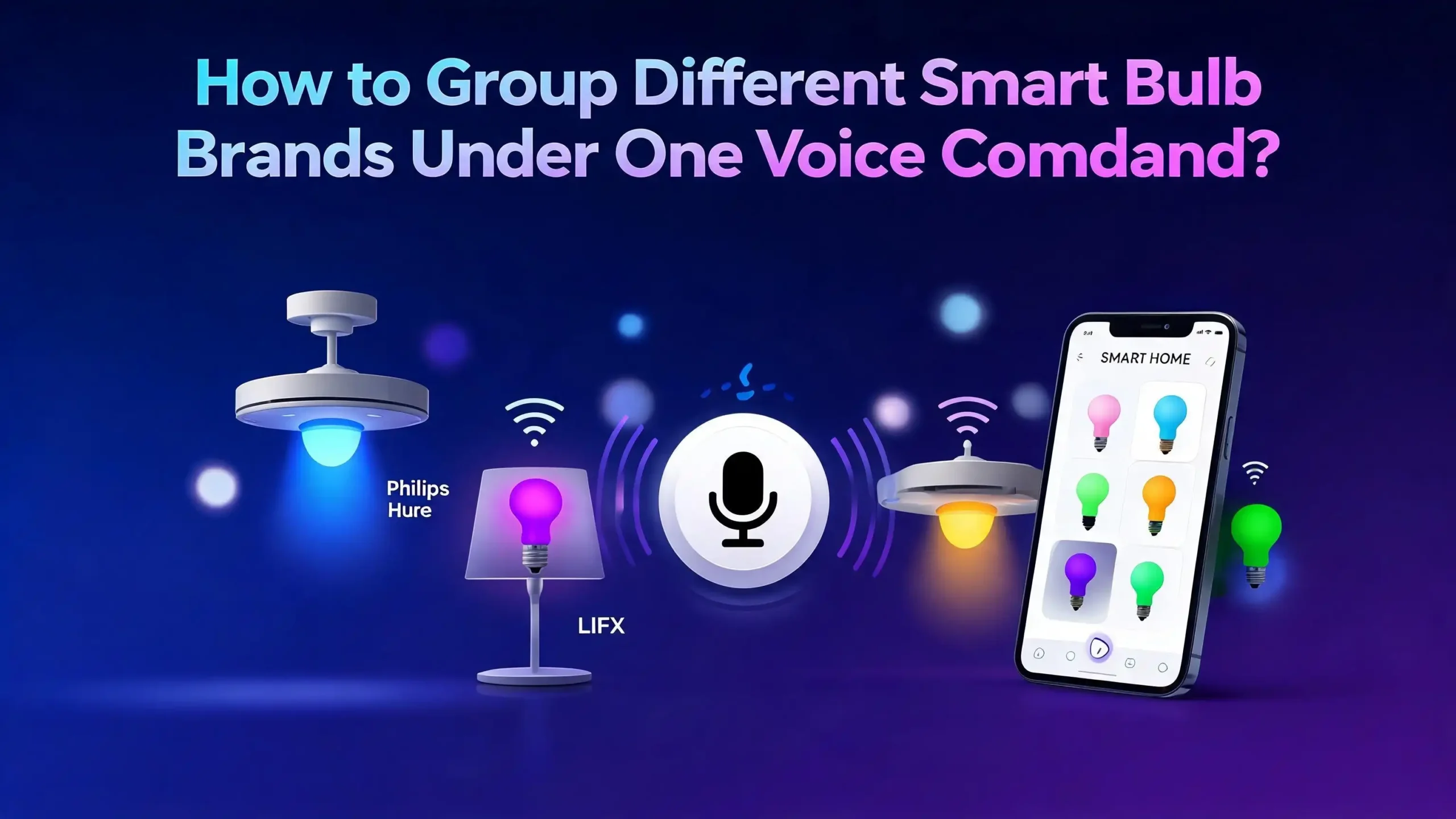
How to Group Different Smart Bulb Brands Under One Voice Command?
You just bought smart bulbs from three different brands. One set is in the living room. Another is in the kitchen. The third set lights up your bedroom. Now you want to say one simple command and have them all respond together. But each brand has its own app, its own setup process, and its own limitations. Sound familiar?
This is one of the most common frustrations in any smart home. You pick bulbs based on price, color options, or availability. Then you realize they live in separate apps and refuse to play nice together.
The good news is that you can absolutely group smart bulbs from different brands under a single voice command. This guide walks you through every practical method to unify your mixed brand smart bulbs.
In a Nutshell
- Voice assistants are your best unifying tool. Amazon Alexa, Google Home, and Apple HomeKit can all group smart bulbs from different brands into a single room or custom group. You do not need bulbs from the same manufacturer to control them together.
- The Alexa app makes grouping the easiest. You can create Smart Home Groups in the Alexa app and add any compatible bulb regardless of brand. One voice command then controls every bulb in that group at once.
- Google Home uses rooms and routines for grouping. You can assign bulbs from different brands to the same room, or create custom routines that trigger multiple lights with a single phrase.
- Matter is the new universal standard. If your bulbs support Matter, they can work across all major platforms without separate apps or hubs. This protocol removes brand barriers at the hardware level.
- Home Assistant offers the most flexibility. For users who want complete control over mixed brand setups, Home Assistant can group bulbs from any brand, any protocol, and any connection type into unified controls.
- Naming your devices properly matters more than you think. Clear, consistent naming prevents confusion and makes voice commands work smoothly across all grouped bulbs.
Why Different Smart Bulb Brands Do Not Work Together by Default
Smart bulb manufacturers build their products around proprietary apps and ecosystems. Philips Hue has the Hue app. LIFX uses the LIFX app. Wyze has the Wyze app. Each brand wants you to stay inside its ecosystem.
This creates a problem. A Philips Hue bulb and a Wyze bulb sitting in the same lamp fixture cannot talk to each other through their native apps. They use different communication protocols, different cloud servers, and different control methods. Hue bulbs often use Zigbee, while many Wyze bulbs connect over Wi-Fi directly.
The core issue is that these brands were not originally designed to communicate with one another. Each company built its own closed system. Your Hue app cannot see your Wyze bulbs. Your Wyze app cannot see your LIFX bulbs. So you end up juggling three or four apps just to control the lights in a single room.
This is exactly why voice assistants and universal platforms exist. They act as a bridge between these separate ecosystems. Alexa, Google Assistant, and Siri can connect to most major smart bulb brands simultaneously. They pull all those separate devices into one unified interface where grouping becomes possible.
How Voice Assistants Solve the Multi Brand Problem
Voice assistants serve as a central hub for all your smart devices. Amazon Alexa, Google Assistant, and Apple Siri each connect to dozens of smart bulb brands through their respective apps. This connection happens through something called “skills” in Alexa, “Works with Google” integrations, or HomeKit compatibility.
Once you link each bulb brand to your voice assistant, all your bulbs appear in one place. The Alexa app shows your Hue bulbs right next to your LIFX bulbs. Google Home displays your Wyze lights alongside your Nanoleaf panels. The brand differences become invisible at this level.
The voice assistant does not care which company made the bulb. It sends commands through the correct channel for each brand automatically. You say “turn off the bedroom lights” and the assistant sends one command to your Hue bridge, another to the LIFX cloud, and another to your Wyze account. All three sets of bulbs turn off within seconds of each other.
This approach requires no additional hardware in most cases. If you already own an Echo speaker, a Nest speaker, or a HomePod, you have everything you need. The voice assistant is the universal translator that lets different brands understand the same command.
How to Group Smart Bulbs in Amazon Alexa
Amazon Alexa offers one of the simplest grouping systems for mixed brand smart bulbs. The process takes just a few minutes and works with almost every major smart bulb brand on the market.
First, make sure you have linked all your smart bulb accounts to the Alexa app. Open the app and go to Devices. Tap the “+” icon and select Add Device. Follow the prompts to enable the skill for each bulb brand you own. For Philips Hue, enable the Hue skill. For LIFX, enable the LIFX skill. Each brand has its own skill in the Alexa store.
After linking, your bulbs should appear in the Devices section. Now you can create a group. Tap the “+” icon again and select Add Group. Choose a room name like “Living Room” or type a custom name. Then select every bulb you want in that group, regardless of brand.
Once saved, say “Alexa, turn on the living room” and every bulb in that group responds. You can also say “Alexa, dim the living room to 50 percent” and all bulbs will adjust together. The grouping works for on/off, dimming, and color changes if the bulbs support those features.
You can create multiple groups and even add the same bulb to more than one group. A living room floor lamp could belong to both the “Living Room” group and a “Movie Night” group with different settings.
How to Group Smart Bulbs in Google Home
Google Home uses a room based organization system that works well for grouping mixed brand bulbs. Every smart device in Google Home gets assigned to a room, and all devices in that room respond to a single command.
Open the Google Home app and tap Devices. Hold down on any smart bulb until its control panel opens. Tap the gear icon to access settings. Select Room and choose which room this bulb belongs to. Repeat this for every smart bulb in your home, assigning each to the correct room.
Now you can say “Hey Google, turn off the kitchen lights” and every bulb assigned to the kitchen will respond. This works across brands. A Sengled bulb and a LIFX bulb in the same room will both respond to the same command.
For more custom groupings, Google Home offers routines. Open the app, tap the Routines tab, and tap Add. Create a trigger phrase like “turn on movie lights” and then add individual actions for each bulb you want included. You can set specific brightness levels, colors, and on/off states for each bulb within the routine.
The routine approach gives you more flexibility than simple room grouping. You can group bulbs from different rooms, set different brightness levels for each, and trigger everything with a single custom phrase. The downside is that you need separate routines for turning lights on and off.
How to Group Smart Bulbs in Apple HomeKit
Apple HomeKit provides clean and reliable grouping for compatible smart bulbs. The system works through the Apple Home app on iPhone, iPad, or Mac.
Every HomeKit compatible device gets assigned to a room. Open the Home app, press and hold on a bulb tile, and tap the settings gear. Assign it to a room. All bulbs in that room respond to commands like “Hey Siri, turn off the bedroom lights.”
HomeKit also supports accessory grouping within rooms. Press and hold on a bulb, tap settings, and select “Group with Other Accessories.” This creates a single tile in the Home app that controls multiple bulbs at once. You can give this group a custom name that Siri recognizes.
For example, group three different brand bulbs in a ceiling fixture and name the group “Ceiling Light.” Now saying “Hey Siri, turn on the ceiling light” controls all three as one unit. The individual bulbs disappear behind a single control.
HomeKit scenes offer another layer of grouping. Create a scene called “Good Night” that turns off bulbs across multiple rooms and brands. Scenes can set specific colors, brightness levels, and power states for every bulb included. One Siri command activates the entire scene instantly.
The main limitation is that not all smart bulb brands support HomeKit natively. However, Matter compatible bulbs work with HomeKit automatically, which greatly expands your options.
Using the Matter Protocol to Unify All Brands
Matter is a universal smart home standard that eliminates brand barriers at the hardware level. Developed by the Connectivity Standards Alliance with support from Amazon, Apple, Google, and Samsung, Matter lets devices from different manufacturers work together without proprietary apps.
A Matter certified smart bulb works with Alexa, Google Home, HomeKit, and SmartThings right out of the box. You do not need to enable separate skills or link brand accounts. Scan the QR code on the bulb, add it to your preferred platform, and it just works.
Matter version 1.5, released in November 2025, is the current specification. Smart bulbs and lighting devices were part of Matter from the very first version, so they have the most mature support of any device category.
One powerful Matter feature is called multi admin. This lets a single bulb belong to multiple platforms at the same time. Your Matter bulb can be controlled by Alexa, Google Home, and HomeKit simultaneously. Each platform maintains its own connection and can group the bulb independently.
If you are buying new smart bulbs today, choosing Matter certified bulbs is the simplest path to cross brand grouping. They work with every major voice assistant and can be grouped in any platform without extra setup steps. Check the Connectivity Standards Alliance certification registry to verify that a bulb is truly Matter certified before purchasing.
How Home Assistant Groups Any Smart Bulb
Home Assistant is an open source smart home platform that provides the most flexible grouping system available. It connects to virtually every smart bulb brand through integrations, regardless of protocol or manufacturer.
Install Home Assistant on a Raspberry Pi, a mini PC, or use the dedicated Home Assistant hardware. Then add integrations for each bulb brand you own. Home Assistant supports Zigbee, Z-Wave, Wi-Fi, Bluetooth, Matter, and Thread devices all in one interface.
Once your bulbs appear in Home Assistant, create a Light Group entity. Go to Settings, then Devices and Services, then Helpers. Select Group and choose Light Group. Add every bulb you want to control together, regardless of brand or protocol.
This Light Group appears as a single light entity. You can add it to dashboards, include it in automations, and control it through voice assistants. Connect Home Assistant to Alexa or Google Home through the cloud or local integrations, and your custom groups become voice controllable.
The biggest advantage of Home Assistant is the elimination of cloud dependency. Commands travel locally within your network, which means faster response times and no reliance on internet connectivity. Bulbs turn on and off almost instantly, without the slight delay that cloud based systems sometimes introduce.
Home Assistant also solves the “popcorn effect” where grouped bulbs turn on one by one instead of simultaneously. Zigbee groups in Home Assistant send a single multicast command that reaches all bulbs at the same time.
Using SmartThings as a Central Hub
Samsung SmartThings works as a powerful central hub for grouping smart bulbs from multiple brands. It supports Zigbee, Z-Wave, Wi-Fi, and Matter devices, making it one of the most versatile platforms available.
The SmartThings app lets you create rooms and assign devices from any supported brand. Every bulb in a room responds to a single tap or voice command. SmartThings connects to both Alexa and Google Assistant, so you can use voice commands through either platform.
SmartThings was one of the fastest platforms to adopt new Matter specifications. It announced support for Matter 1.5 within weeks of the specification release. This means newer device categories and features become available on SmartThings before many competing platforms.
Create lighting groups in SmartThings by opening the app, selecting a room, and adding all your bulbs to that room. You can also create Scenes that set specific states for multiple bulbs across different rooms. A “Welcome Home” scene could turn on the hallway, living room, and kitchen lights to specific brightness levels with one tap.
SmartThings routines add automation to your groups. Set your grouped lights to turn on at sunset, respond to motion sensors, or activate when you arrive home. The combination of grouping, scenes, and routines gives you complete control over mixed brand smart bulb setups.
The SmartThings Station includes a built in Thread border router, which means it also serves as a foundation for Matter over Thread devices.
How to Name Your Devices for Smooth Voice Commands
Proper device naming is critical for reliable voice control of grouped smart bulbs. Poor naming causes confusion, misidentified devices, and failed commands. A few minutes of thoughtful naming saves hours of frustration later.
Give each bulb a clear, descriptive name that includes its location. Instead of “Light 1” or “Bulb A,” use names like “Bedroom Lamp Left,” “Kitchen Counter Light,” or “Living Room Floor Lamp.” This makes individual control easy and prevents the voice assistant from guessing which light you mean.
Avoid naming a device the same as its room or group. If you have a group called “Kitchen,” do not name a bulb “Kitchen.” This creates conflicts in the voice assistant’s logic. Instead, name the bulb “Kitchen Ceiling” or “Kitchen Island Light” and put it in the group called “Kitchen.”
For bulbs in the same fixture, use sequential naming. Name them “Chandelier 1,” “Chandelier 2,” and “Chandelier 3.” The voice assistant will treat any command referencing “Chandelier” as applying to all of them in some platforms, or you can group them manually.
Keep names short and easy to pronounce. Voice assistants sometimes struggle with unusual words or long phrases. “Desk Lamp” works better than “My Special Reading Light on the Side Table.” Simple names lead to faster recognition and fewer command failures.
Review your device names every few months, especially after adding new bulbs or rearranging rooms. Consistent naming conventions across your entire home make the system feel unified, even with bulbs from five different brands.
How to Create Scenes and Routines Across Brands
Scenes and routines take grouped bulbs to the next level of automation. Instead of just turning lights on or off, you can set specific brightness levels, colors, and schedules for every bulb in a group with a single command.
In Alexa, create a Routine by opening the app, going to More, and selecting Routines. Set a trigger phrase like “Alexa, movie time.” Then add actions for each bulb or group. Dim the living room to 20 percent, set the bias light behind the TV to warm white, and turn off the kitchen lights. One phrase controls everything.
Google Home routines work similarly. Create a routine with a custom trigger phrase and add individual actions for each device. You can set different brightness and color values for each bulb within the routine. This gives you per bulb control within a single voice command.
Apple HomeKit scenes allow you to set exact states for every accessory included. Open the Home app, tap the “+” icon, and select Add Scene. Name it, add your bulbs, and set the desired state for each one. Activate the scene with Siri or a single tap.
Routines also support time based triggers. Set your morning routine to gradually brighten bedroom lights at 7 AM. Schedule evening routines to dim all lights at 9 PM. Combine motion sensor triggers with light groups so hallway lights from three different brands turn on together when you walk through.
The key is to build routines that match your actual daily patterns. Start with three or four basic routines and expand from there as you discover new needs.
Troubleshooting Common Issues With Multi Brand Groups
Grouping smart bulbs from different brands does not always go smoothly. Several common problems have straightforward fixes that save you from unnecessary frustration.
The popcorn effect is the most frequent complaint. You give a command and bulbs turn on one after another instead of simultaneously. This happens because the voice assistant sends individual commands to each bulb through different cloud services. Wi-Fi bulbs from different brands will almost always have a slight delay between them. The fix is to use a local hub like Home Assistant with Zigbee multicast groups, or accept a minor delay with cloud based systems.
One bulb in the group does not respond. Check if that bulb’s skill or integration is still linked in your voice assistant app. Cloud connections sometimes disconnect after password changes or app updates. Re-link the skill and the bulb should reappear.
Voice commands control the wrong group. This usually stems from naming conflicts. If you have a group called “Lights” and another called “Living Room Lights,” the assistant might pick the wrong one. Use distinct, specific names for every group to avoid overlap.
Bulbs show as “unresponsive” in the app. This often means the bulb lost its Wi-Fi connection or the brand’s cloud server is down. Restart the bulb by toggling its physical switch off and on. If the issue persists, check the brand’s app directly to confirm the connection.
Color and brightness do not match across brands. Different brands use different color temperature scales and dimming curves. Setting all bulbs to “warm white” might produce slightly different shades. Manually adjust each bulb’s settings within the group until they match visually.
Future Proofing Your Smart Bulb Setup
Technology moves quickly, and the smart bulbs you buy today should still work well with your system years from now. A few strategic choices protect your investment.
Buy Matter certified bulbs whenever possible. Matter is backed by Amazon, Apple, Google, and Samsung. It is the agreed upon standard for smart home devices going forward. Matter bulbs will work with current and future platforms without needing brand specific integrations.
Consider bulbs that use Thread as their connection protocol. Thread creates a mesh network where each bulb strengthens the overall connection. Thread 1.4, now required for all new certified devices, ensures that border routers from different brands share one unified mesh. This eliminates the fragmented network problems that plagued earlier Thread versions.
Keep your voice assistant hardware reasonably current. Older Echo devices and Nest speakers may lack Thread border routers, which limits your ability to use newer Matter over Thread bulbs. A device released after 2021 from any major brand typically includes the necessary hardware.
Avoid building your entire system around one brand’s proprietary features. If a brand discontinues its cloud service, bulbs that depend on it become useless. Matter and local control through platforms like Home Assistant protect against this risk because they do not require a manufacturer’s cloud to function.
Update firmware on all your smart bulbs regularly. Manufacturers release updates that improve compatibility, add features, and fix bugs. A bulb that shipped with Matter 1.0 support might gain Matter 1.3 features through a firmware update. Check for updates in each brand’s app at least once a month.
Step by Step Summary: The Fastest Way to Group Mixed Bulbs
If you want the quickest path to grouping different brand bulbs under one voice command, follow these steps.
Step one: Choose your primary voice assistant. Alexa is the easiest for grouping. Google Home works well with routines. HomeKit is best for Apple households. Pick one as your main control platform.
Step two: Link every smart bulb brand to your chosen assistant. In Alexa, enable skills. In Google Home, link accounts through the Works with Google system. In HomeKit, add devices through the Home app or use Matter pairing.
Step three: Name every bulb clearly. Use location based names like “Office Desk Lamp” or “Bathroom Vanity.” Avoid generic names and never name a device the same as its room.
Step four: Create groups or rooms. In Alexa, create a Smart Home Group and add your bulbs. In Google Home, assign bulbs to rooms. In HomeKit, group accessories together and assign them to rooms.
Step five: Test your voice commands. Say “turn on the [room name]” and verify that every bulb responds. Adjust any bulbs that fail to respond by checking their connection and skill status.
Step six: Build routines for advanced control. Create custom commands for specific scenarios like “movie time” or “good morning” that set each bulb to your preferred state.
Step seven: Add Matter bulbs for future purchases. Every new bulb you buy should be Matter certified to ensure long term compatibility across all platforms. This single decision simplifies every future grouping task.
Following these steps, you can group bulbs from any combination of brands and control them all with a single voice command in under 30 minutes.
Can I group Philips Hue and LIFX bulbs in the same voice command?
Yes. Both Philips Hue and LIFX work with Alexa, Google Home, and HomeKit. Link both brands to your preferred voice assistant, then add them to the same room or group. A single voice command like “turn off the living room” will control both brands simultaneously. The process takes just a few minutes through your voice assistant’s app.
Do I need a smart home hub to group different brand bulbs?
Not always. If your bulbs connect over Wi-Fi and support Alexa or Google Home, you can group them using just the voice assistant app on your phone and a compatible speaker. However, a hub like SmartThings or Home Assistant provides faster response times, local control without internet, and more advanced grouping options. Zigbee and Z-Wave bulbs do require a compatible hub.
Will all grouped bulbs turn on at exactly the same time?
There is often a slight delay between bulbs, especially with cloud based Wi-Fi bulbs from different brands. This is called the popcorn effect. For near simultaneous control, use Zigbee bulbs with a hub that supports multicast group commands, or choose Matter over Thread bulbs connected to a local controller. The delay with cloud systems is usually under two seconds and is acceptable for most users.
What happens if one brand’s app or cloud service goes down?
If a brand’s cloud service goes down, bulbs from that brand will stop responding to voice commands until the service recovers. Bulbs from other brands in the same group will continue to work normally. To avoid this risk, consider using Matter certified bulbs or a local control hub like Home Assistant, which does not depend on cloud services to operate your lights.
Can I set different brightness levels for different brand bulbs in one group?
Standard room groups set the same brightness for all bulbs. To set different brightness levels for individual bulbs within a single command, use routines or scenes. Alexa Routines, Google Home Routines, and HomeKit Scenes all let you define specific brightness and color values for each bulb individually, then trigger everything with one voice command or phrase.
Is Matter worth choosing for new smart bulb purchases?
Matter is the best choice for new smart bulb purchases in 2026. It works with Alexa, Google Home, HomeKit, and SmartThings without needing brand specific skills or integrations. Matter bulbs support multi admin, which means one bulb can belong to multiple platforms at the same time. The standard continues to receive updates and broad industry support, making it the most future proof option available today.

Hi, I’m Simmy — the founder and voice behind AI Gadgets Insight. I’m a tech enthusiast who loves exploring the latest AI gadgets, smart devices, and innovative tech products. I started this blog to help people make smarter tech choices with honest reviews, easy-to-follow comparisons, and practical buying guides.